


Project Report: Daytime Farrowing Protocol for Sows
1. Project Overview
1.1 Trial Farm
A commercial multipliersow farm in Henan Province, China.
1.2 Trial Period
November – December 2024
1.3 Farm Profile
This newlybuilt automated multiplier sow farm houses a full capacity of 600 Frenchline sows and operates on a 36 day batchproduction system. Its production team has six staff members, with five onsite during regular working days.
Previously, dinoprostbased farrowing induction was implemented. Even so, farrowing within each unit would stretch across 34 days. Staff had to take turns for roundtheclock farrowing assistance, resulting in heavy workloads. Night time entry intoproduction zones also created challenges for biosecurity supervision.
2. Project Objectives
Shift the majority of sow farrowing to daytime hours
Shorten farrowing duration
Reduce the incidence of postpartum reproductive inflammation in sows
3. Trial Design & Procedures
3.1 Group Allocation
To guarantee reliable results, experimental units were defined as farrowing rooms. Sows with matching expected farrowing dates from
the same production batch were randomly assigned to either the treatment group or the control group.
Table 1 Trial Grouping
Batch | Group | Unit | Number of Sows | Treatment |
202410 | Control Group | Unit 1 | 34 | Farrowing induction with PG |
Treatment Group | Unit 2 | 45 | PG + Cbabetocin |
3.2 Trial Protocol
Control group: On the morning (8:00 a.m.) one day prior to the expected farrowing date, each sow received 0.2 mg cloprostenol sodium via intramuscular injection. Farrowing performance was closely monitored, with standard farrowing assistance carried out as usual.
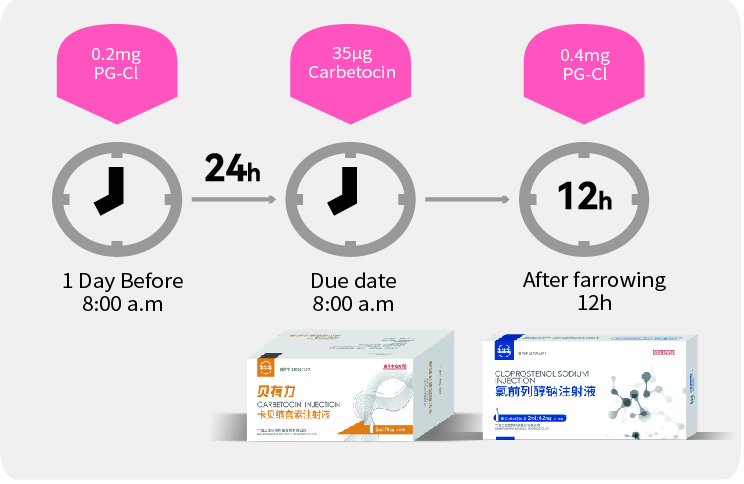
Treatment group:
8:00 a.m., one day before expected farrowing: intramuscular injection of 0.2 mg cloprostenol sodium per sow.
Exactly 24 hours later (8:00 a.m. on the predicted farrowing day): 35 μg Carbetocin was injected intramuscularlybehind the ear for every sow, regardless of whether farrowing had commenced.
Within 12 hours postfarrowing: each sow received 0.4 mg cloprostenol sodium intramuscularly for uterus care.
Farrowing events and sow conditions were continuously recorded for both groups.
Timeline for the uterinecare protocol in the treatment group: Day before expected farrowing (08:00): cloprostenol sodium
0.2mg. Expected farrowing day (08:00, +24 h): Carbetocin 35 μg Within 12 h after farrowing: cloprostenol sodium 0.4 mg.
4. Trial Outcomes
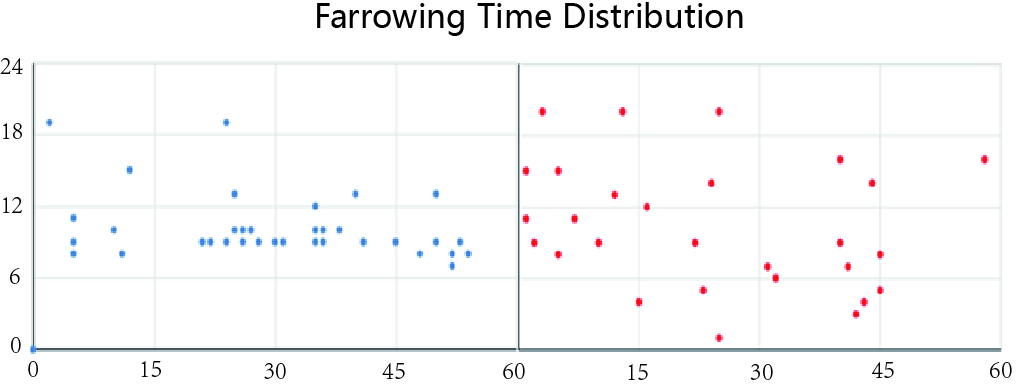
4.1 Increased proportion of daytime farrowing
Treatment group: 45 sows enrolled. Excluding animals that farrowed before Carbetocin administration, 40 sows remained for evaluation. 37 out of these 40 farrowed during daytime, reaching a 92.5 % daytimefarrowing rate, concentrated
mostly in the morning hours.
Control group: 34 sows in total. Only 17 farrowed in daytime, equivalent to a 50 % daytimefarrowing rate, withfarrowing times widely scattered across day and night.
4.2 Reduced farrowing duration
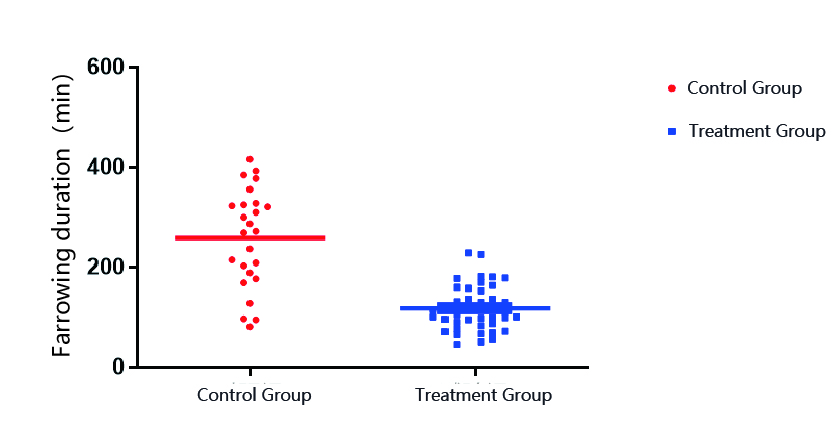
The control group averaged 257 minutes per farrowing event. The treatment group's average farrowing duration dropped to 117 minutes — a reduction of 140 minutes. Data dispersion was also lower; nearly all sows in the treatment group completed farrowing within 180 minutes.
4.3 Lower incidence of postpartum inflammation
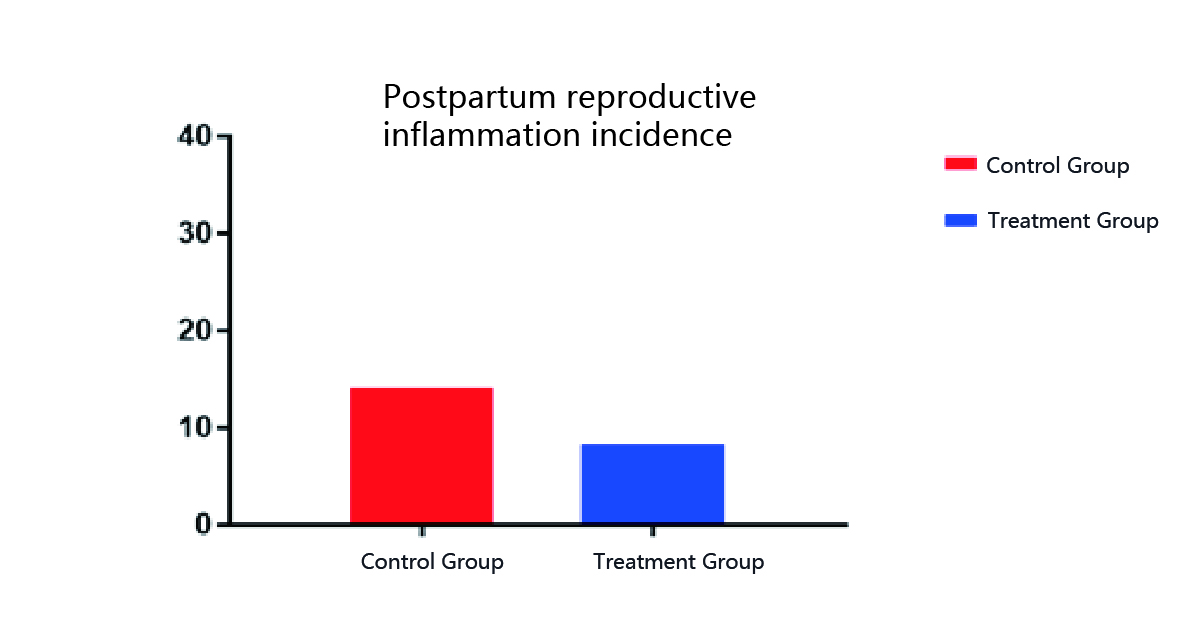
The incidence of postpartum reproductive inflammation stood at 14.71 % in the control group. For the treatment group, this figure fell to
8.89 %, representing an absolute reduction of 5.82 percentage points and a relative drop of 39.56 %.
4.4 Discussion
After rolling out this uterinecare protocol, the farrowing window per barn unit shrank from 34 days to 1.5 days.
A 92.5 % daytimefarrowing rate was achieved on the predicted farrowing day, substantially relieving staff from overnight farrowing duties.
Besides concentrating farrowing into working hours, the protocol shortened farrowing length and cut postpartum inflammation risk.
These improvements support faster physical recovery for sows after parturition.
Disclaimer: Technical content is intended for veterinary and farming professionals only. All data are derived from onfarm production records.


