


Trial of Carbetocin for Inducing Daytime Synchronized Farrowing in Sows
[Li Qin¹, Li Tao², Bai Jiahua³, Chai Weidong², Wang Dong⁴, Liu Yan³, Weng Shiqiao², Tian Jianhui¹*
¹ College of Animal Science and Technology, China Agricultural University, Beijing, China;
² Ningbo Sansheng Biotechnology Co., Ltd., Ningbo 315000, Zhejiang, China;
³ Institute of Animal Husbandry and Veterinary Medicine, Beijing Academy of Agriculture and Forestry Sciences, Beijing 100097, China;
⁴ Institute of Animal Science, Chinese Academy of Agricultural Sciences, Beijing, China]
Abstract
To investigate the optimal dosage of carbetocin and its efficacy in inducing daytime synchronized farrowing in sows, 98 periparturient sows were randomly assigned to four groups. Upon delivery of the first piglet, sows in Treatment Groups 1, 2 and 3 received intramuscular neck injections of carbetocin at 17.5 μg, 35 μg and 70 μg per sow respectively, while the control group was administered 1 mL normal saline per sow. Farrowing interval, placenta expulsion time, assistedfarrowing rate, total litter size, number of stillborn piglets and mummified fetuses were recorded. In a separate field trial involving 2 834 periparturient sows from 19 largescale pig farms, animals were divided into two groups. Sows in the cloprostenol group (n = 1 335) were injected with cloprostenol sodium at 09:00 on gestation day 114. Sows in the cloprostenolpluscarbetocin group (n = 1 499) received cloprostenol sodium at 09:00 on gestation day 114, followed by carbetocin injection 24 h later. Parameters including average farrowing duration, farrowing interval, average total litter size, average number of liveborn piglets, average number of white stillborn piglets, proportion of daytime farrowing and incidence of postpartum inflammation were evaluated.
The results showed that farrowing intervals were significantly shortened (P < 0.05) in all three carbetocintreated groups compared with the control, with Group 2 (35 μg carbetocin per sow) exhibiting the best performance. Therefore, the 35 μg persow dose was selected for subsequent research on daytime synchronized farrowing. The cloprostenolpluscarbetocin group presented highly significant improvements in daytime farrowing proportion, average farrowing duration and farrowing interval (P < 0.001), alongside significant reductions in average white stillborn count (P < 0.05) and postpartum inflammation rate (P < 0.05).
These findings indicate that combined use of carbetocin and cloprostenol sodium can effectively induce daytime synchronized farrowing, improve sow and piglet health, and provide solid technical support for batch production in largescale pig operations.
Keywords: carbetocin; cloprostenol sodium; sow; farrowing duration; proportion of daytime farrowing
DOI: 10.19848/j.cnki.ISSN 10052739.2025.02.0002
Introduction
Conventional pig production systems are characterized by high resource consumption, low production efficiency and elevated disease risks. It is therefore urgent to establish all-in and all-out batch production technologies to improve farm management efficiency and biosecurity. The core of batch farming lies in synchronized sow reproduction, and the degree of farrowing synchronization directly determines the overall efficiency and quality of batch reproductive management.
In traditional breeding models, inconsistent mating and farrowing timepoints prevent standardized batch production. Although the popularization of timed artificial insemination has greatly improved mating synchronization, farrowing events remain scattered across batches due to environmental fluctuations, herd scale and individual physiological differences. A high proportion of nighttime farrowing increases the workload of on-site delivery and piglet care, raising the risks of piglet mortality and sow postpartum complications.
Synchronized farrowing technology regulates the sow delivery process via exogenous hormone intervention to simulate physiological hormonal changes, thereby concentrating farrowing events and increasing the proportion of daytime delivery. This strategy enables rational allocation of human and material resources, standardized delivery care, improved piglet survival rate and growth performance, and reduced labor costs. Furthermore, synchronized farrowing ensures consistent age and body condition among nursery, replacement and finishing pig batches, supporting precise immunization and accurate nutritional management. This effectively enhances herd health status, production performance and overall economic benefits of pig farming.
Prostaglandin F2α (PGF2α) and its analogs can effectively induce luteolysis and synchronized farrowing. Approximately 80% of pregnant sows complete delivery within 36 hours after PGF2α analog injection. However, this technique still has limitations, including asynchronous farrowing initiation, inconsistent farrowing duration and prolonged delivery processes. Supplemental oxytocin application can narrow individual differences and shorten farrowing duration and piglet birth intervals. Nevertheless, improper oxytocin use may cause excessive uterine contraction and increased stillbirth rate.
As a synthetic polypeptide oxytocin agonist, carbetocin exhibits high physiological activity similar to endogenous oxytocin. It binds specifically to uterine oxytocin receptors to enhance uterine contraction frequency and tension, generating stable and effective farrowing intensity. Compared with natural oxytocin, carbetocin provides longer-lasting uterine regulation and avoids the adverse effects of frequent high-frequency uterine contraction, shortening the total farrowing duration by more than one hour.
Given the superior pharmacological properties of carbetocin, this study firstly screened the optimal carbetocin dosage for sow farrowing regulation, and further explored the synergistic effect of carbetocin combined with cloprostenol sodium on daytime synchronized farrowing. The findings aim to optimize sow reproductive management and provide technical support for the standardized and efficient batch production of large-scale pig farms.
Materials and Methods
1.1 Test Drugs
Cloprostenol sodium injection and carbetocin sodium injection were supplied by Ningbo Sansheng Biotechnology Co., Ltd. Normal saline was purchased from Zhejiang Jimin Pharmaceutical Co., Ltd. The specifications and batch numbers of the test drugs were as follows: cloprostenol sodium injection, 2 mL: 0.2 mg, Batch No. S220201; carbetocin injection, 20 mL: 0.7 mg, Batch No. F220306; normal saline, 500 mL: 4.5 g, Batch No. 17080411.
1.2 Experimental Animals and Treatment Protocols
The experimental subjects were Landrace × Yorkshire crossbred sows. All sows were fed standard compound feed in accordance with the nutritional requirements at different physiological stages. Routine immunization and deworming were performed before the trial initiation. Strict biosecurity and disinfection protocols were implemented throughout the experimental period. Daily health inspections were conducted to monitor sow physiological status and exclude individuals with abnormal symptoms such as hyperthermia. The trial consisted of two independent experiments.
Experiment 1 was conducted on a commercial pig farm in Ningbo, Zhejiang Province.
A total of 98 periparturient sows were disinfected and transferred to farrowing rooms 5–7 days before the expected delivery date. The sows were randomly divided into four groups: three treatment groups (25 sows per group) and one control group (23 sows). Immediately after the delivery of the first piglet, sows in the three treatment groups received intramuscular neck injections of carbetocin at doses of 17.5 μg, 35 μg, and 70 μg per sow, respectively. Sows in the control group were injected with 1 mL of normal saline per sow at the same anatomical site.
Experiment 2 was carried out across 19 large-scale commercial pig farms in China.
A total of 2,834 sows approaching the expected farrowing date were selected, disinfected, and transferred to farrowing rooms 5–7 days before delivery. The sows were randomly allocated into two groups.
In the cloprostenol group (n = 1,335), sows received an intramuscular neck injection of 0.2 mg cloprostenol sodium per sow at 09:00 on gestation day 114.
In the cloprostenol plus carbetocin group (n = 1,499), sows were administered 0.2 mg cloprostenol sodium at 09:00 on gestation day 114, followed by a 35 μg carbetocin injection per sow 24 hours later.
1.3 Measurement Indicators
Sow farrowing assistance, lactation, and feeding management were performed in accordance with routine farm operating procedures.
In Experiment 1, recorded indicators included sow ear tag number, drug administration time, farrowing initiation time, delivery time of each piglet, and placenta expulsion time, which were used to calculate piglet birth interval. Artificial farrowing assistance status was documented to determine the assistance rate. In addition, total litter size, number of stillborn piglets, and mummified fetuses were statistically analyzed.
In Experiment 2, monitored parameters comprised sow ear tag number, total farrowing duration (from the delivery of the first piglet to the last piglet), and piglet birth interval. Daytime farrowing was defined as delivery occurring between 06:00 and 18:00, and the proportion of daytime farrowing sows was calculated. Reproductive performance indicators including average total litter size, average number of live-born piglets, and average number of white stillborn piglets were recorded. The incidence of postpartum uterine inflammation (characterized by uterine purulent discharge from 7 days post-farrowing to subsequent mating) was statistically counted.
1.4 Data Analysis
All experimental data were analyzed using SPSS 24.0 software, and results were presented as mean ± standard deviation.
In Experiment 1, one-way analysis of variance (ANOVA) combined with LSD multiple comparison was used for inter-group difference analysis of quantitative indicators, and the Chi-square (χ²) test was applied for count data such as farrowing assistance rate.
In Experiment 2, data from 19 pig farms were integrated, and a two-tailed t-test was performed with the drug administration regimen set as the fixed effect.
Differences with P < 0.05 were considered statistically significant, and differences with P < 0.001 were considered extremely significant.
Results and Analysis
2.1 Effects of different carbetocin dosages on farrowing interval and placenta expulsion time in sows
Compared with the control group, the farrowing intervals were significantly reduced in sows treated with carbetocin at 17.5 μg, 35 μg and 70 μg per sow (P < 0.05), whereas no significant differences were observed among the three treatment groups (P > 0.05). The results indicated that carbetocin effectively shortened farrowing intervals within the dosage range tested. The 35 μgpersow group (Treatment Group 2) achieved the shortest farrowing interval and exhibited the optimal performance. No significant intergroup differences were detected for placenta expulsion time (P > 0.05), although the shortest placenta expulsion time was recorded in Treatment Group 2.
Table 1 Effects of different carbetocin dosages on farrowing interval and placenta expulsion time in sows
Group | No. of sows | Farrowing interval / h | Placenta expulsion time / h |
Treatment Group 1 | 25 | 0.21 ± 0.10b | 2.18 ± 1.40a |
Treatment Group 2 | 25 | 0.16 ± 0.06b | 2.05 ± 1.45a |
Treatment Group 3 | 25 | 0.22 ± 0.13b | 2.17 ± 1.46a |
Control group | 23 | 0.31 ± 0.16a | 2.24 ± 1.77a |
Note: Values within the same column with different superscript letters differ significantly (P < 0.05); values sharing identical superscript letters are not significantly different (P > 0.05).
2.2 Effects of different carbetocin dosages on assistedfarrowing rate and farrowing performance
The assistedfarrowing rates for Treatment Groups 1, 2, 3 and the control group were 40.0 %, 20.0 %, 40.0 % and 39.1 %, respectively, with no significant differences among groups (P > 0.05). The 35 μgpersow group yielded the lowest assistedfarrowing rate. Insufficient uterine contractility in late farrowing was observed in several sows of the highdose 70 μg group, leading to an elevated assistedfarrowing rate. It is speculated that the high dosage triggered excessive earlystage uterine contraction followed by subsequent uterine fatigue. Total litter size did not differ significantly across groups. Collectively, 35 μg per sow was identified as the optimal dosage for the subsequent largescale combineddrug trial.
Table 2 Effects of different carbetocin dosages on assistedfarrowing rate and farrowing performance of sows
Group | No. of sows | Assistedfarrowing rate / % | Total litter size | No, of stillborn piglets | No, of Mummified fetuses |
Treatment Group 1 | 25 | 40.0a | 13.76 ± 3.03a | 0.76 ± 0.72a | 0.366 ± 0.70a |
Treatment Group 2 | 25 | 20.0a | 13.68 ± 3.85a | 0.56 ± 0.65a | 0.12 ± 0.60a |
Treatment Group 3 | 25 | 40.0a | 13.40 ± 3.48a | 1.00 ± 1.41a | 0a |
Control group | 23 | 39.1a | 13.00 ± 3.19a | 0.97 ± 0.87a | 0.09 ± 0.42a |
Note: Identical superscript letters within the same column indicate no significant intergroup difference (P > 0.05).
2.3 Effects of cloprostenol sodium combined with carbetocin on farrowing duration and farrowing performance
Compared with cloprostenolsodium monotherapy, the combined cloprostenolsodium + carbetocin treatment highly significantly shortened average farrowing duration and farrowing interval (P < 0.001). Average total litter size and average number of liveborn piglets showed no significant differences between the two groups (P > 0.05). The average number of white stillborn piglets decreased significantly in the combinedtreatment group (P = 0.015 < 0.05), demonstrating that the combined regimen shortened farrowing and reduced the risk of piglet asphyxiation during parturition.
Table 3 Effects of two synchronizedfarrowing treatments on farrowing duration and farrowing performance of sows
Item | Cloprostenol group | Cloprostenol+ carbetocin group | P‑value |
Numberof pig farms | 19 | 19 | —— |
Numberof sows | 1335 | 1449 | —— |
Averagefarrowing duration / h | 4.29± 0.95 | 2.90± 0.54 | <0.001 |
Farrowinginterval / h | 0.30± 0.06 | 0.21± 0.04 | <0.001 |
Averagetotal litter size | 14.29± 1.52 | 13.79± 1.65 | 0.310 |
Averagenumber of live‑born piglets | 12.76± 1.59 | 12.56± 1.62 | 0.702 |
Averagenumber of white stillborn piglets | 1.06± 0.46 | 0.73± 0.40 | 0.015 |
2.4 Influences of combined medication on daytimefarrowing proportion and postpartum uterine inflammation
Proportion of daytime farrowing: The daytimefarrowing proportion reached only 68.9 % in the cloprostenolsodium singleinjection group, while it increased to 95.8 % in the cloprostenolsodium + carbetocin group, representing a highly significant difference (P < 0.001). This greatly reduces the workload of nightshift farrowing supervision.
Incidence of postpartum uterine inflammation: The postpartum uterineinflammation rate was 8.3 % for cloprostenolsodium monotherapy and dropped to 2.6 % in the combinedmedication group (P < 0.05). Improved uterine recovery favors subsequent reproductive performance of sows.
Figure 1 Effects of two synchronizedfarrowing treatments on daytimefarrowing proportion and postpartum uterine inflammation in sows
Proportion of daytime farrowing / % Postpartum inflammation proportion / %

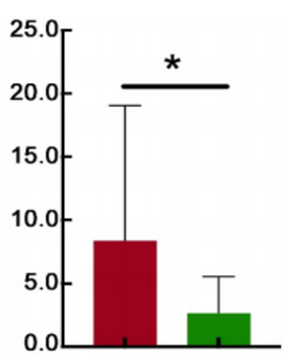
Red bar: Cloprostenol group Green bar: Cloprostenol + carbetocin group
Note: * indicates significant difference (P < 0.05); ** indicates highly significant difference (P < 0.001). Left panel: proportion of daytime farrowing; right panel: incidence of postpartum uterine inflammation.
Discussion
3.1 Analysis of the optimal application dosage of carbetocin
Carbetocin features longlasting action and high safety and can modulate the parturition process in domestic animals. Previous studies have confirmed that both 35 μg and 70 μg dosages shorten farrowing intervals without altering total stillbirth counts. Exogenous carbetocin enhances the contractile strength of uterine smooth muscle and shortens farrowing intervals. Nevertheless, excessive dosages provoke persistent intense uterine contraction and insufficient uterine blood supply, raising the risk of intrauterine asphyxia in piglets.
In the present trial, sows receiving the high 70 μgpersow dose exhibited excessive uterine contraction in early farrowing followed by uterine exhaustion at later stages, accompanied by higher assistedfarrowing and stillbirth rates. The medium 35 μgpersow dose delivered the shortest farrowing interval, faster placenta expulsion and the lowest assistedfarrowing rate, balancing oxytocic efficacy and safety; hence it represents the optimal dosage of domesticproduced carbetocin for inducing sow parturition.
Placenta expulsion depends on sustained mild uterine contraction. The 35 μg dosage maintains stable uterine contractions, facilitates complete placenta discharge and lowers the risk of retained placenta, making it suitable for batch application in largescale pig farms.
3.2 Improved outcomes of combined medication for sow farrowing duration and piglet survival
Natural farrowing in sows generally lasts 46 h. Prolonged farrowing readily causes piglet hypoxiaasphyxia and reduced neonatal vitality. Cloprostenol sodium initiates parturition and shortens baseline farrowing duration; supplementary carbetocin further strengthens uterine contraction and compresses total farrowing time as well as birth intervals between piglets.
The present field trial verified that combined medication does not reduce total litter size or liveborn counts, yet significantly decreases fresh white stillbirths. Two major mechanisms account for this effect: shortened farrowing duration limits the duration of intrauterine hypoxia for piglets; more than 95 % of sows farrow during daytime under human surveillance, allowing timely intervention for dystocia and weak piglets and lowering piglet mortality.
Some literatures report that carbetocin may slightly increase umbilicalcord rupture risk. However, largescale farm data from this study suggest that the overall production benefits outweigh this minor risk, supporting its safe practical application.
3.3 Production value of concentrated daytime farrowing and postpartum inflammation control
Under natural conditions, sows tend to farrow at night. Insufficient nighttime manpower frequently leads to piglet crushing, hypothermia of weak neonates, sow dystocia and retained placenta, and also elevates the risk of postpartum uterine infection in sows. Prostaglandinonly induction yields a daytimefarrowing proportion of merely 50 %80 %. The combination of cloprostenol sodium plus 35 μg carbetocin raises the daytimefarrowing rate to 95.8 %, concentrating farrowinghouse workload within daytime hours, cutting nightlabor costs and improving care quality.
Postfarrowing uterine inflammation within 7 days postpartum was markedly reduced under combined treatment. Two underlying mechanisms are proposed: shortened farrowing and smooth placenta discharge minimize birthcanal injury and intrauterine residual debris; adequate daytime supervision ensures standardized assistedfarrowing and proper disinfection, decreasing exogenous bacterial infection. Reduced uterine inflammation shortens postpartum recovery, stabilizes annual litter output and improves longterm reproductive profitability of pig herds.
Conclusions
Intramuscular neck injection of carbetocin after delivery of the first piglet significantly shortens farrowing intervals in sows. The dosage of 35 μg per sow is safe and optimal, whereas the high dose (70 μg per sow) easily triggers dysregulated uterine contraction and higher dystocia incidence.
Standardized synchronizedfarrowing protocol: inject cloprostenol sodium (0.2 mg per sow, intramuscularly in the neck) at 09:00 on gestation day 114, followed by intramuscular carbetocin (35 μg per sow) 24 h later.
This combined regimen highly significantly shortens total farrowing duration and farrowing interval of sows, lifting the daytimefarrowing proportion from 68.9 % to 95.8 %. Meanwhile, it significantly reduces the incidences of parturitionrelated stillbirth and postpartum uterine inflammation.
The synchronizedfarrowing technology combining cloprostenol sodium and carbetocin simultaneously optimizes sow reproductive health and piglet survival. It fits the allinallout batchproduction system of largescale pig farms and possesses broad popularization and application prospects.
参考文献
[1] DE RENSIS F,SALERI R,TUMMARUK P,et al. Prostaglandin F2α and control of reproduction in female swine:a review[J]. Theriogenology,2012,77(1):1-11.[2] HAMMOND D,MATTY G. A farrowing management system using cloprostenol to control the time of parturition[J]. The Veterinary Record,1980,106(4):72-75.[3] DE RENSIS F,SOTTOCORONA M,KIRKWOOD R N. Effect of prostaglandin and dexamethasone injection on farrowing and piglet neonatal growth[J]. The Veterinary Record,2002,151(11):330-331.[4] KAEOKET K. The effect of dose and route of administration of R-cloprostenol on the parturient response of sows[J]. Zuchthygiene,2006,41(5):472-476.[5] CASSAR G,KIRKWOOD R,FRIENDSHIP R,et al. Sow and litter performance following farrowing induction with prostaglandin:Effect of adjunct treatments with dexamethasone or oxytocin[J]. Journal of Swine Health and Production,2005,13(2):81-85.[6] ATKE A,VILHARDT H. Uterotonic activity and myometrial receptor affinity of 1-deamino-1-carba-2-tyrosine(O-methyl)-oxytocin[J]. Acta Endocrinologica,1987,115(1):155-160.[7] CORDOVANI D,BALKI M,FARINE D,et al. Carbetocin at elective cesarean delivery: a randomized controlled trial to determine the effective dose[J]. Journal Canadien D’anesthesie,2012,59(8):751-757.[8] 牛鹏飞,王燕春,蒋明。卡贝缩宫素对母猪繁殖性能的影响[J]. 猪业科学,2022,39(8):108-109.[9] SU L L,CHONG Y S,SAMUEL M. Carbetocin for preventing postpartum haemorrhage[J]. Cochrane Database of Systematic Reviews,2012(2):CD005457.[10] WARD S A,KIRKWOOD R N,PLUSH K L. Effects of oxytocin and carbetocin on farrowing performance[J]. Animal Reproduction Science,2019,205:88-93.[11] ZAREMBA W,UDLUFT T,BOSTEDT H. Effects of various procedures for synchronisation of parturition in sows. Assessment of sows with a complication-free birth[J]. Tierarztliche Praxis Ausgabe G,Grosstiere/Nutztiere,2015,43(5):269-277.[12] ALONSO-SPILSBURY M,MOTA-ROJAS D,VILLANUEVA-GARCÍA D,et al. Perinatal asphyxia pathophysiology in pig and human:a review[J]. Animal Reproduction Science,2005,90(1/ 2):1-30.[13] BJÖRKMAN S,OLIVIERO C,RAJALA-SCHULTZ P J,et al. The effect of litter size,parity and farrowing duration on placenta expulsion and retention in sows[J]. Theriogenology,2017,92:36-44.[14] KIRKDEN R D,BROOM D M,ANDERSEN I L. Piglet mortality: The impact of induction of farrowing using prostaglandins and oxytocin[J]. Animal Reproduction Science,2013,138(1-2):14-24.[15] GOKULDAS P P,TAMULI M K,MOHAN N H,et al. Farrowing response and piglet viability following Cloprostenol-induced farrowing in Duroc sows with prolonged gestation[J]. Journal of Applied Animal Research,2015,43(2):153-156.[16] 朱雪丹,张新科,周乐乐。不同剂量 D - 氯前列醇钠对初产母猪诱导分娩的影响[J]. 中国畜牧杂志,2023,59(10):254-260.[17] 张亮,柴捷,潘红梅,等。氯前列醇钠与卡贝缩宫素对荣昌猪和涪陵黑猪母猪分娩时间的影响[J]. 浙江农业学报,2022,34(5):915-922.[18] VONGSARIYAVANICH S,SUNDARAKETU P,SAKULSIRAJIT R,et al. Effect of carbetocin administration during the mid-period of parturition on farrowing duration,newborn piglet characteristics,colostrum yield and milk yield in hyperprolific sows[J]. Theriogenology,2021,172:150-159.[19] 曹勤忠,凌天星,邹晓亮。氯前列烯醇控制母猪白天分娩试验[J]. 畜禽业,2000,11(5):40-41.[20] 吴旧生。氯前列烯醇诱导大约克夏母猪同期分娩试验[J]. 中国兽医科技,2003,33(2):48-50.[21]杨兵,韩玉帅,孟艺婷。卡贝缩宫素对夏季母猪繁殖性能的影响[J]. 猪业科学,2024,41(12):91-94.


